Building resilient coastal livelihoods by integrating seaweed cultivation, ecological stewardship and women-led enterprise.
In January 2023, we launched the Seaweed Cultivation Training Project to empower women and women’s groups through Amrita’s integrated vocational training approach.
The initiative aims to promote sustainable livelihoods while addressing economic and environmental challenges.
Seaweed is a highly adaptable marine resource with applications across food, agriculture, bio-products and biofuels.
Seaweed cultivation offers rural women the knowledge and skills needed to establish farming and processing as a sustainable livelihood.
Beyond its economic benefits, seaweed cultivation can contribute to environmental sustainability through carbon sequestration and habitat restoration.
Blue is the New Pink is a community-based seaweed initiative designed to strengthen coastal livelihoods by placing women at the centre of cultivation, conservation and enterprise.
Build women's leadership and resilience in coastal livelihoods.
Create stable and sustainable income opportunities for coastal communities.
Support environmental regeneration of coastal ecosystems.
Strengthen local ownership of marine-based value chains.
Connecting coastal communities across Tamil Nadu, Kerala, Andhra Pradesh and Karnataka through skills, sustainable livelihoods and coastal conservation.
One coastal network. Connecting local skills, sustainable livelihoods and marine ecosystem stewardship.
Guided by Amrita's holistic approach, the project links women's empowerment, livelihoods and environmental care.
Discover the journey of the seaweed initiative.
Building sustainable coastal livelihoods through women's skills, seaweed cultivation, enterprise and environmental stewardship.
Train women’s groups in seaweed cultivation over two years, encompassing two cultivation cycles, using Amrita’s integrated vocational training model.
Facilitate the formation of collective businesses among trained women and their families, fostering sustainable livelihoods and community empowerment.
Toward achieving its objectives, the project was structured into three phases, or training cycles. The first cycle took place in the coastal region of Olaikuda, within the Rameswaram municipality of Tamil Nadu.
By adopting a holistic approach and leveraging advanced technologies, the initiative equips women with the knowledge and skills required for sustainable, climate-smart aquaculture. This empowers not only the women but also their entire communities, fostering socio-economic development and environmental sustainability through sustainable seaweed farming.
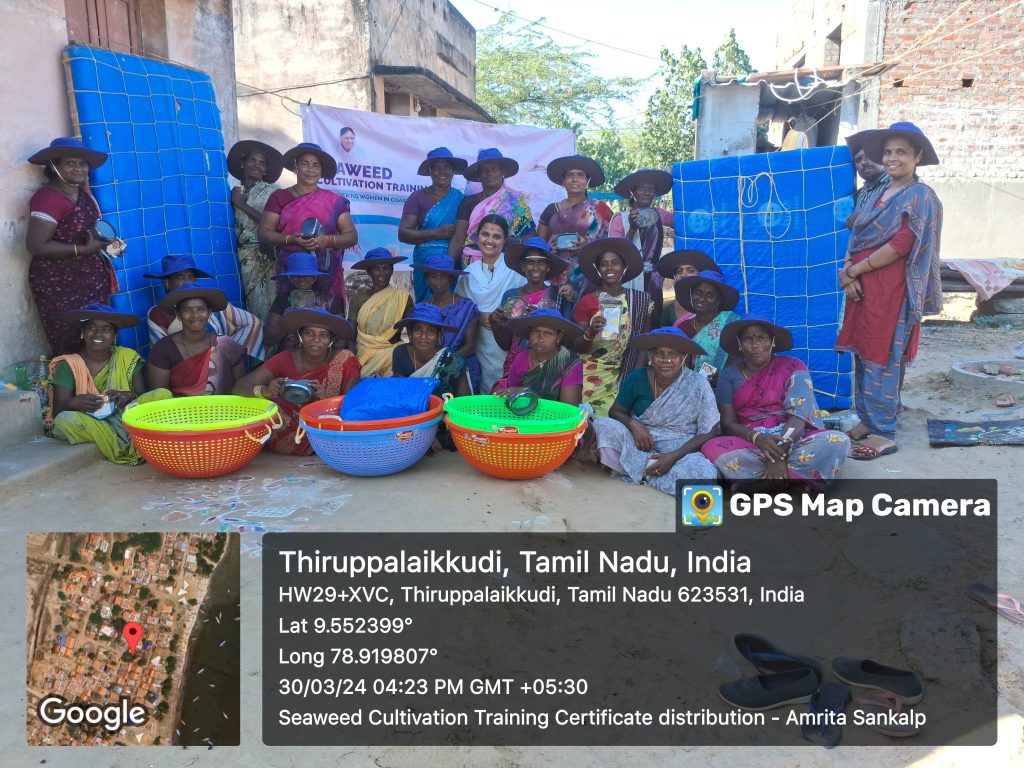
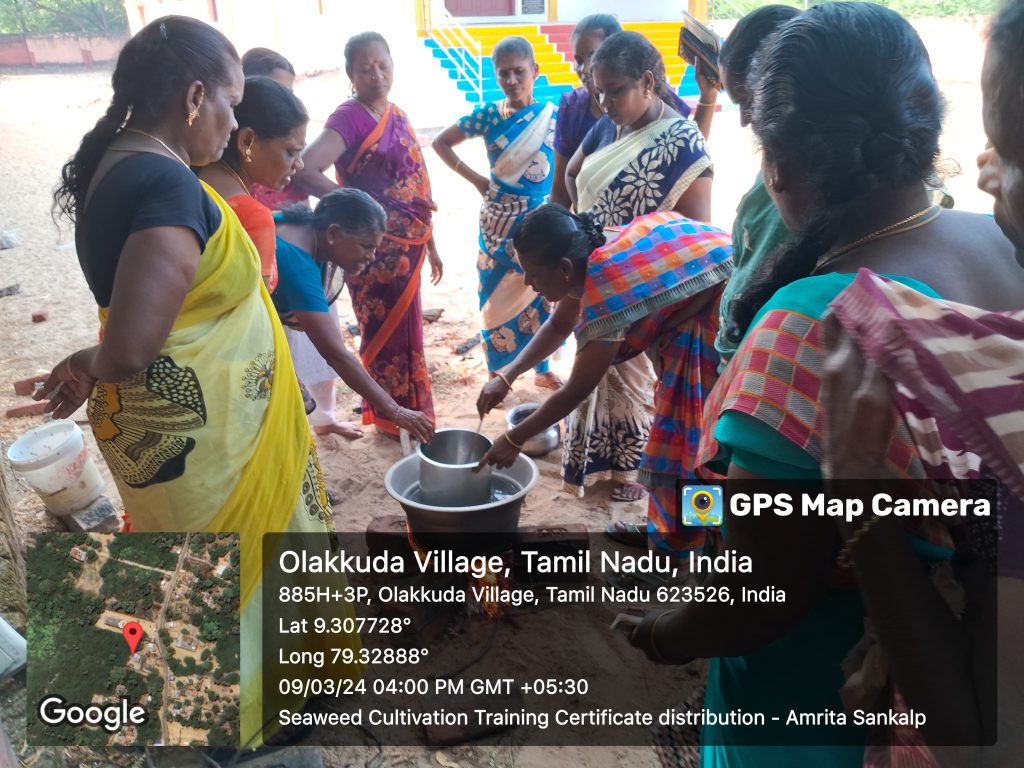
The initiative has successfully trained 64 women (40 in 2023, 24 in 2024) in sustainable seaweed farming, providing them with the necessary skills and tools for cultivation.
Over 10,000 kg of seaweed were harvested from two farms in Olaikuda and Thirupalikudi villages in Ramanathapuram, generating a total income of ₹193,960 for participants.
30 women received certifications from the National Skill Development Corporation (NSDC), enhancing their credentials and employability.
265 rafts, six monoline plots, poyaboats, and other essential tools were distributed to trainees to support cultivation.
Training was also provided in value-added product development, such as seaweed-based soaps and pickles, enabling women to diversify their income streams.
Outreach efforts extended to 16 villages, connecting with local stakeholders, including government bodies, vendors, and research institutions. Community engagement activities and market studies deepened understanding of local dynamics, amplifying the project’s impact.
In recognition of these efforts, Dr. Bhavani Rao R, Dean of the School of Social and Behavioural Sciences at Amrita University and lead of this project, along with the field team, were invited to the inauguration of the Seaweed Cultivation Park in Ramanathapuram by Dr L. Murugan, Hon’ble Minister of State of Fisheries, Animal Husbandry and Dairying.
The women who were trained in seaweed cultivation from Olaikuda spoke at the event and shared their inspiring story:
“Before, we used to help our husbands. Now, they help us.”
Trainees from the Olaikuda program are now beneficiaries under the Pradhan Mantri Matsya Sampada Yojana, a flagship initiative launched by the Government of India in 2020 (PMMSY scheme), which aims to transform the fisheries and aquaculture sector in the country by focusing on sustainable development, modernization, and improving the socio-economic conditions of fishers and fish farmers.
The program also incorporated a “Go to Market” study for seaweed products, conducted by students from the Ross School of Business, University of Michigan, USA, as part of their action-based learning project. This collaboration offered valuable insights into market opportunities and business development, aligning with national skill frameworks and further empowering participants to thrive in the growing seaweed industry.
Women Driving Sustainable Seaweed Cultivation and Climate Solutions
In 2024, we launched the next phase of our seaweed cultivation initiative, titled “Blue is the New Pink: Women Driving Sustainable Seaweed Cultivation and Climate Solutions.”
This initiative is funded under the Global Environment Facility (GEF) Small Grants Programme (SGP) Operational Phase 7 and is implemented in collaboration with UNDP, the Ministry of Environment, Forests and Climate Change, and The Energy and Resources Institute (TERI). Additional partners include ESRI and Transworld Group.
This phase aims to empower 100 women from rural coastal communities in Ramanathapuram, Tamil Nadu, by equipping them with technical expertise and life skills in seaweed cultivation, seagrass meadows restoration and conservation, and Integrated Multi-Trophic Aquaculture (IMTA). These activities contribute to both the socio-economic upliftment of the communities and the conservation of marine ecosystems, directly supporting SDG 14 (Life Below Water).
The initiative facilitates the creation of women-led small business units to encourage entrepreneurial activities and ocean conservation efforts while exploring the potential for blue credits as an innovative financial model.
The intervention spans approximately 115 hectares of improved marine habitat practices.
We are currently conducting a needs assessment in the Indian Gulf of Mannar Biosphere Reserve to identify sustainable livelihood opportunities that align with the preservation of Dugong habitats.
This assessment, in collaboration with UNESCO and the Surabhi Foundation, includes:
This initiative aims to strike a balance between economic development and biodiversity conservation, ensuring long-term benefits for local communities and the marine ecosystems they depend upon.
The initiative combines environmental action, women's empowerment, skills development and sustainable livelihoods.
The project contributes to women's empowerment, sustainable livelihoods, climate action and marine ecosystem conservation.
Women-led skills, leadership and enterprise.
Sustainable livelihood and entrepreneurship opportunities.
Climate-smart livelihoods and environmental stewardship.
Sustainable marine livelihoods and conservation of ocean ecosystems.
Explore moments from training, cultivation and seaweed-based enterprise activities.
Empowering coastal women, strengthening livelihoods and nurturing healthier marine ecosystems.
Explore the Brochure


